-03%20logo%20website.png)

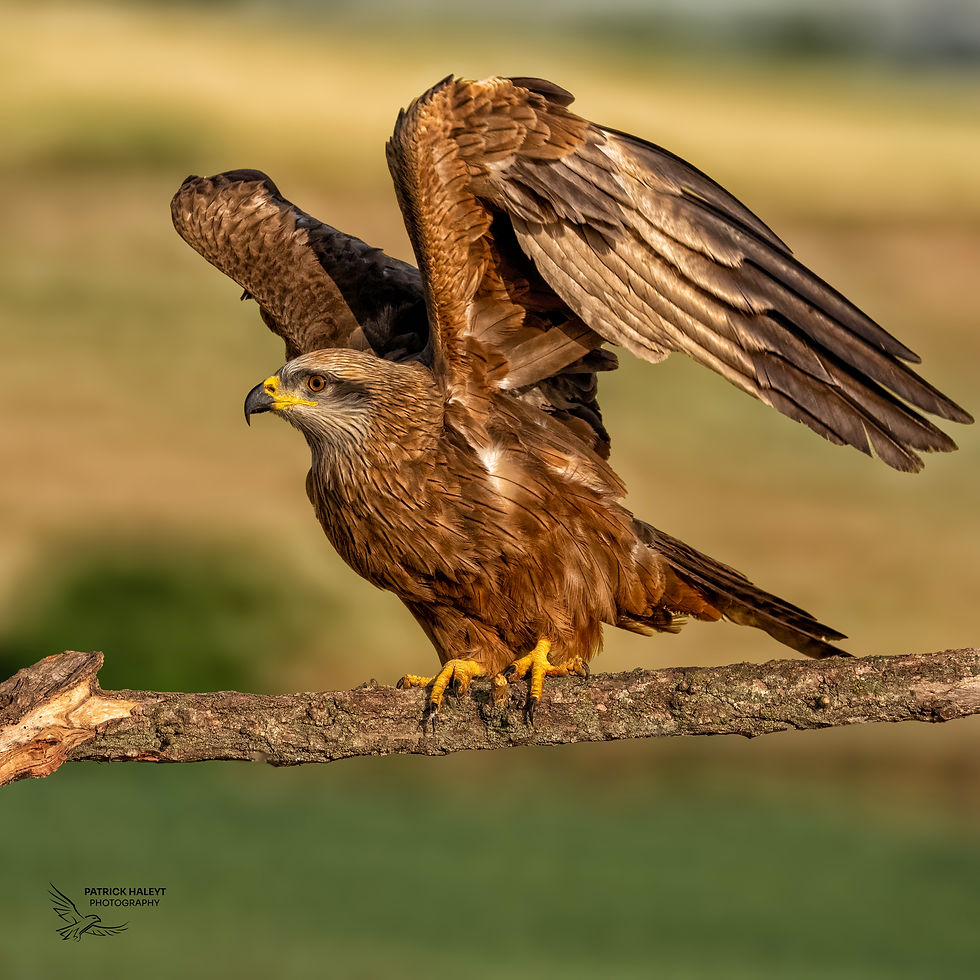
The Black Kite (Milvus Migrans)
Welcome at the Raptor Academy: The Black Kite
The species:
The name Milvus is derived from the Latin word for bird of prey. The Latin word Migrans means 'Migrating'.
Actually, the name Black Kite isn’t really that fitting. The brown naming like in Italian (Nibbio bruno) or Swedish (Brun glada) would be more appropriate.
Features:
Length = 55-60 cm
Wingspan = 140-150 cm
Weight = male approx. 800g, female approx. 850g
The Black Kite has long, fairly broad wings and a long tail that is usually shallowly forked at the end, not as deep as the Red Kite. The plumage color is mainly dark brown; only the head is usually noticeably lighter with dark streaks.
Young birds have a slightly lighter-colored body compared to adults and light edges on the wing coverts. The plumage of immature Black Kites (2nd to 5th year of life) can be clearly distinguished from juvenile and adult plumage due to the light beige color of the head and neck.
The change in iris color from light brown to yellow seems to occur only in the 7th or 8th year of life.
Distribution:
The Black Kite is reportedly the most numerous raptor in the world. Its range stretches from Northwest Africa across Europe to Central Asia, and further east to China and Japan. The northern boundary in Europe runs from northern France through Belgium, North Rhine-Westphalia, along the Baltic coast, Poland, and southern Finland. Black Kites are social birds, which allows large concentrations to form in areas with plenty of food.
Hunting and food:
The Black Kite searches for food during a slow flight, low above the ground and open terrain, and over a water surface. They are also sometimes seen in urban areas. Often, they snatch dead or sick fish from the water surface. Besides that, they also like to eat carrion and steal prey from other bird species. They also hunt specifically for small mammals and birds.
Threats and protection:
Poisoning, pollution of water and food, and changes in the landscape (high-rise buildings, wind turbines, etc.) are the biggest threats to the species.
In Belgium, the protection and monitoring of the Black Kite fall under the general activities of organizations like Vogelbescherming Vlaanderen, Natuurpunt, and their Walloon counterpart Ligue Royale Belge pour la Protection des Oiseaux (LRBPO).
Because it’s a European protected bird of prey, these organizations focus on: habitat restoration, quiet zones, and fighting illegal practices.
The photographer is watching:
The biggest challenge is lighting their dark plumage and capturing their unpredictable flight. Black kites are mostly dark brown to grayish black. Cameras tend to overexpose dark subjects (making them look gray). Use your exposure compensation wisely. With a bright sky as the background, you often need to overexpose by +0.7 to +1.7 stops to keep the details in the feathers.
Black Kites soar a lot, but can suddenly dive or make razor-sharp turns to grab food. Continuously use autofocus AF-C in combination with Bird/Eye AF if your camera supports it. Choose a flexible spot or zone focus area so the camera doesn’t immediately focus on the background when the bird changes direction. Use a shutter speed between 1/2000s - 1/3200s for flight shots or spectacular dives to get the wingtips sharp. For a sitting bird, you can go lower than 1/2000s. For depth of field, you can work with an aperture of f5.6 or f8. This gives you some margin to get the bird sharp from head to tail. ...
Recognition and behavior for the photographer:
The forked tail is THE characteristic of the Black Kite. They constantly use their tail like a rudder. Watch this steering behavior; as soon as the tail tilts, the bird is about to change direction. Black Kites are very social and often hunt in groups, for example above landfills, freshly mowed meadows, or bodies of water. If you see one, there are often more. This offers unique opportunities for interaction photos.
Try to photograph the bird when it’s flying lower or from a hill/viewpoint so you’re not just shooting straight up. A background of trees or mountains gives you much more depth. Always leave extra space in your composition on the side the bird is flying towards.
Gallery


