-03%20logo%20website.png)

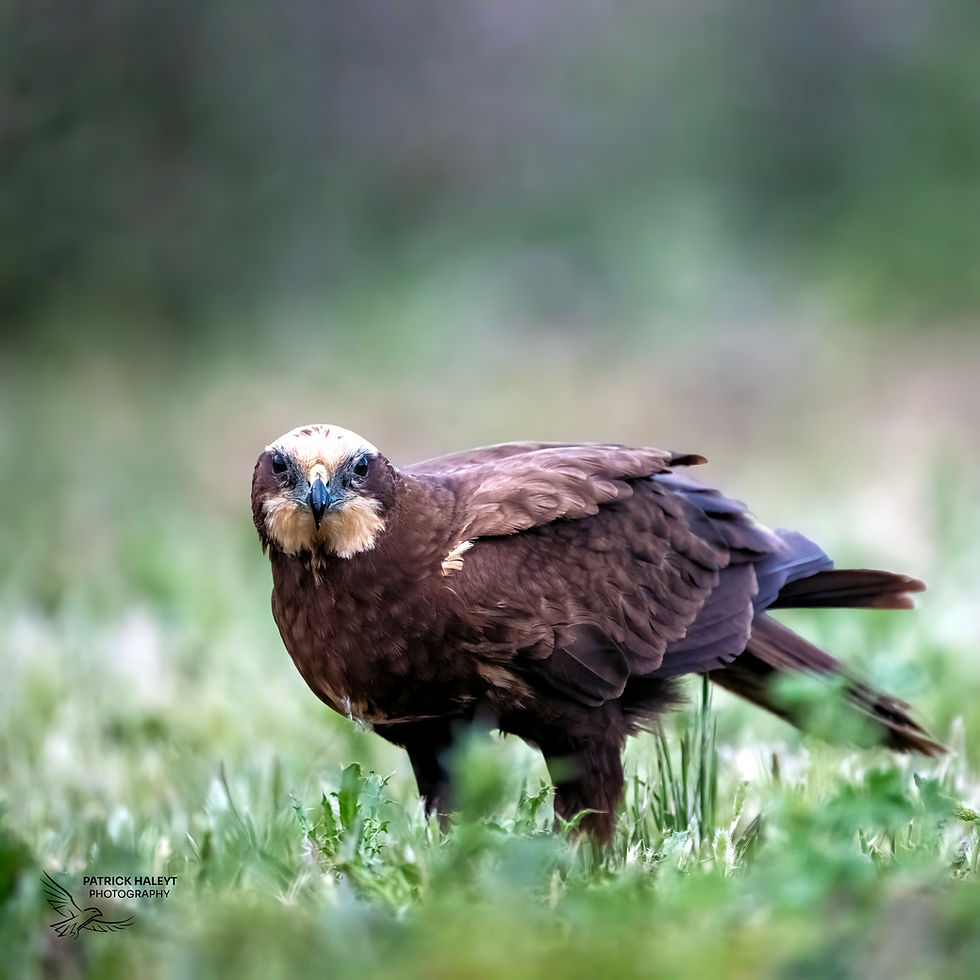
The Marsh Harrier (Circus Aeroginosus)
Welcome at the Raptor Academy: The Marsh Harrier

The species:
The Latin name Circus means 'Harrier', while the also Latin word aeruginosus can be translated as 'Rust-colored', and refers to the color of the belly and thigh feathers of the adult male.
Features:
Length: 48-56cm (of which 18-20cm is tail)
Wingspan: 115-130cm
Weight: male around 540g, female around 740g
The Western Marsh Harrier is the largest harrier in Europe and is about the same size as the Buzzard, but is more slender and has a different way of flying. Usually, this species can be seen in a low, gliding flight, with the long and broad wings held slightly up in a V.
The two sexes have different colors in their adult plumage. Adult males have dark brown back and shoulder feathers, wings that are grey with a black tip, a long light grey tail, and a yellowish-white head and neck with dark brown streaks, while the belly and thighs are rust-colored.
Adult females are almost entirely plain brown, only the crown, throat, and wing coverts are creamy colored. Young birds, which are also dark brown, have crowns and throats that are not as light, but reddish-brown to yellowish.

Distribution:
The range stretches from Northwest Africa and the countries around the Mediterranean in the south across much of Europe to southern Sweden and southern Finland, and eastwards through a wide belt across Asia and northern Japan. Like other harriers, the Western Marsh Harrier is usually found in open areas, mainly in lowlands, while mountainous regions in Central Europe are mostly avoided. Primarily, this species breeds in reeds and rushes in the marshy fringes of open waters. Sometimes, even small clumps of reeds can serve as breeding sites, as long as there is no disturbance.
Hunting and food:
Hunting harriers use surprise attacks by suddenly swooping low over reeds, water, and the surrounding land. They usually catch their prey on the ground, less often on water or in flight. Even in dense vegetation, they can locate prey, like squeaky mice, thanks to their excellent hearing, and grab them with their long legs. Besides small mammals, a lot of birds are also caught during the breeding season, often young ones that have just left the nest. When field mice are abundant, however, they make up the main part of the diet.
Threats and protection:
Especially in Southern and Eastern Europe, the species is threatened. This is due to habitat destruction caused by the draining of marshes, which can also affect broods. In Spain, natural periods of drought have also caused a catastrophic decline. Besides human or climatic disturbances, losses also occur due to foxes, wild boars, crows, and gulls. To protect them, marsh areas with reed beds, where Western Marsh Harriers can breed undisturbed, need to be maintained. To protect broods in cereal fields, it is recommended to designate a 30m x 30m area around the nest where no mowing is allowed until the young can fly.
The photographer is watching:
For successfully photographing the Western Marsh Harrier, a fast shutter speed, a zoom lens, and a lot of patience are crucial.
Shutter speed: Use a shutter speed of 1/1000s to 1/4000s to capture the slow glide and dives sharply.
Aperture: Choose an aperture around f8 to ensure the whole bird is in focus.
Autofocus: Set your camera to AF-C (continuous) with Zone setting to track the moving bird.
Know the behavior: Western Marsh Harriers often patrol in a slow, steady line low over the same field or reed bed searching for prey.
Prey transfer: During the breeding season, partners sometimes transfer prey to each other while flying; this provides spectacular shots.
Action moments: Shoot a burst of images the moment the bird rises from or dives into the reeds.
Patience: The right combination of light, background, and posture requires a lot of patience...
Gallery


